
About Covert Mail: Morse & Ciphers
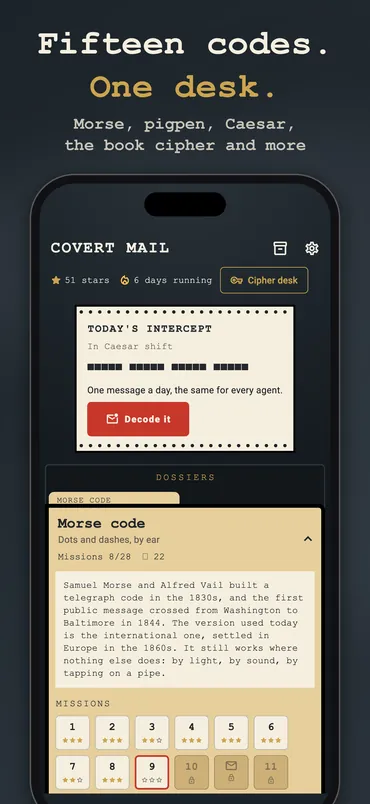
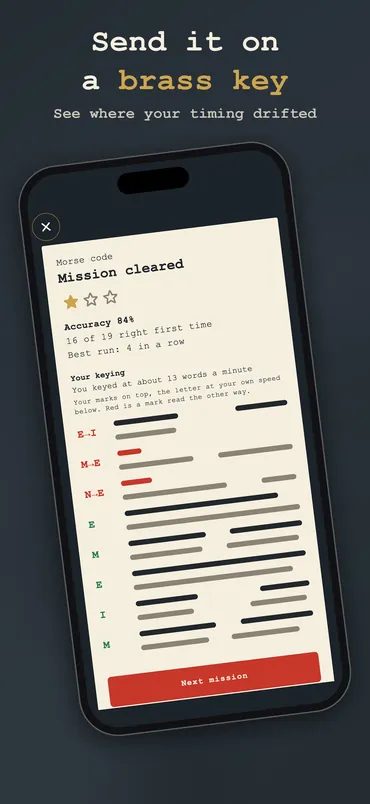
Covert Mail is a field desk of secret codes. Each code is a dossier: read its history, practice it a few characters at a time, then decode a real message to file it in your archive. There are fifteen: Morse code, the NATO phonetic alphabet, the Caesar shift, Atbash, tap code, pigpen, Braille, the Polybius square, flag semaphore, a keyword cipher, Vigenère, the rail fence, ROT13, a substitution cipher and a book cipher. Once you can hear Morse, you learn to send it on an on-screen brass key.
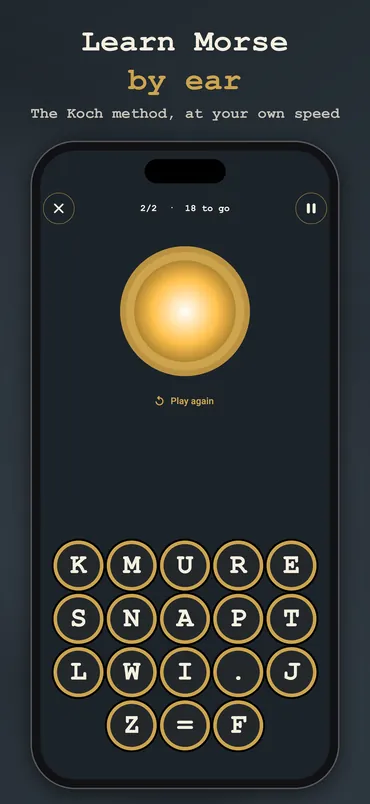
Morse is learned the way radio operators learn it, by ear. The Koch method plays every character at full speed from the first lesson, two at a time, so you hear each one as a single sound instead of counting dots; Farnsworth spacing adds room between characters while you learn. The tones are made on the phone at any speed and pitch, with a signal lamp on the screen and optional vibration. Practice is planned around the characters you miss, and a miss comes back a few clues later until it sticks. A new intercept arrives every day, the same for everyone.
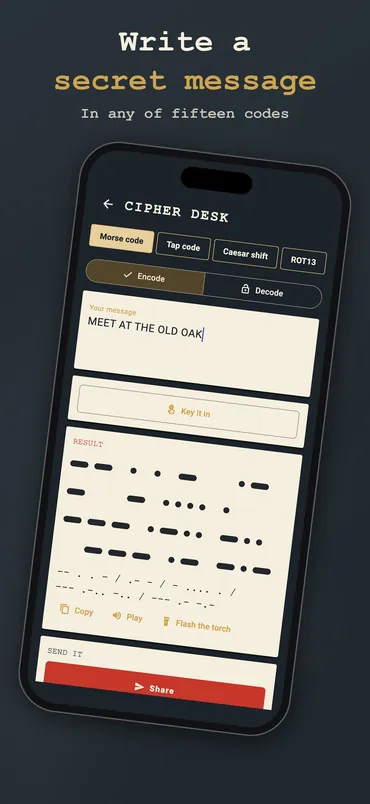
The cipher desk encodes and decodes anything in fifteen codes, including ROT13, a random substitution alphabet and a book cipher with any book you choose. It plays Morse aloud or flashes it on the phone’s torch, and sends a coded message to a friend through any messaging app, with or without the key. Every code it has also works here in the browser.
It pays you nothing: no coins, no balance and no cash-out, which is why it sits apart from the reward apps. It is free, with nothing to buy. There is one banner, at the foot of the desk, and never one during a mission or on the cipher desk; every ad request is marked as directed at children, so it is not personalized. There is no account, and progress stays on the phone. What the app sends is set out in its own privacy policy.
Covert Mail was the first app this studio made: it came to the App Store in 2009 to scramble a text message with a PIN, and was retired in 2016 when messaging apps made that pointless. This is a rewrite from the ground up, and it is not in either store yet. This page will carry the download buttons the day each listing goes live, not before.
Screenshots
How to use it in the moment
- Read the briefing and open the Morse code dossier.
- Start Mission 1: two letters, K and M, and no clock.
- Listen to each signal and tap the letter it spells.
- Clear a mission to open the next, and a dossier’s dispatch to file a real message in the archive.
- Open the cipher desk, write a message in any code and share it.
Features
- Fifteen codes and ciphers, each with its history
- Send Morse on a brass key, with your timing shown
- Morse by ear with the Koch method and Farnsworth spacing
- Tones made on the phone at any speed and pitch
- A signal lamp on screen, the torch and vibration
- Practice planned around the characters you miss
- A daily intercept, the same for everyone
- An archive of famous real messages to unlock
- A cipher desk for fifteen codes, both ways
- Send a coded message with or without its key
- Two-pane layouts on iPad and Android tablets
- No account; progress stays on the phone
Frequently asked questions
When is it coming out?
It's coming soon to the App Store and Google Play, for iPhone, iPad and Android. This page will carry the download buttons the day each listing goes live, and not before.
Is it real encryption?
No. These are classical codes, for learning and for fun. A determined person can break every one of them, which is part of the point: the app teaches how. Don't use them to protect real secrets.
Does my friend need the app to read my message?
It helps: a friend with the app pastes the message in and it opens on the right code. Without it, the code's name travels with the message, so they can decode it on the code pages here or by hand.
Does this app pay me anything?
No. It has no coins, no balance and no cash-out. The apps we publish that pay are on our apps page.
Is it free?
Yes, with nothing to buy. There's one banner at the foot of the desk and never one during a mission, and the ads are marked as directed at children, so they're not personalized.
Can I try it in my browser?
The app itself, no. But every code it teaches has a working translator in the browser, Morse with sound and light.
Everything else we publish
 Daily: Learn and EarnEducation
 Step and EarnHealth & Fitness
 Play and EarnGames
 Todo and EarnProductivity
 Taco Rain: Catch the TacosCasual
 Peel FrenzyCasual
 Asteroid DuelAction
 Pie Cannon: Carnival ShootoutCasual
 Ship It: Build an App StudioSimulation
 Bramble KnightPlatformer
 BroadsideArcade
 Acorn TrailPuzzle
 Wobble WheelieArcade
 Tilt DuoArcade
 HoverlineRacing
 Mix a BeastCasual
 Sizzle SwapCasual
 Community Stress First AidHealth & Fitness
 Apps That PayFinance
 Stitch Keeper: Row CounterLifestyle
 Handyman CalcTools
 Card Lab: Trading Card MakerEntertainment
 Dead Center: Card CenteringTools
 Practice Proof: Practice LogMusic & Audio
 Househand: Home MaintenanceHouse & Home
 Chess Clock & ScorepadTools
 Initiative Tracker: DM ToolsEntertainment