About Ship It: Build an App Studio
Ship It is a top-down game about the least cinematic job there is. You are one person in one office, seen from above, and you get around it by tapping where you want to be. Sit at your desk and you write code. Stand at the coffee machine and your focus comes back. Eat something at the fridge and it comes back and stays up. Stand at the whiteboard and you build a plan that makes the next stretch of code worth more. When there is enough code, you ship, and what the launch earns buys a better keyboard, a chair you can sit in longer, and eventually other people at the other desks.
The office does not leave you alone. Focus drains while you are in the chair, so a run is a rhythm rather than a grind: work, get up, come back. Bugs land on desks and stop them dead until somebody walks over and deals with it — including somebody else's desk, which you have to cross the room for. Buy the build server and it writes code all night and then breaks at the worst moment, and the only fix is to go and stand at the rack. None of that is a countdown you lose to. It is a reason to be somewhere other than the chair.
The nine apps you ship are our nine apps. Taco Rain, Peel Frenzy, Pie Cannon, Asteroid Duel, Todo and Earn, Step and Earn, Play and Earn, Daily: Learn and Earn and Community Stress First Aid — the same ones on our apps page and in this section. Each one goes up on the office wall as you finish it, and on the card at the end every one is a link to its own page. The order you build them in is a difficulty curve rather than a history: Taco Rain is first because 25 lines is a sensible opening cost, not because it came first.
How long a run takes is up to how much you get out of your chair, and the three figures are measured rather than guessed — the game's own test suite plays full runs against the real economy. Using the whole office takes about thirteen minutes. Living on coffee and never planning anything takes about thirty-four. Never getting up at all still finishes, in about seventy-six, which is the point: low focus makes the work worth less rather than stopping it. Either way it ends — there is a finish card, not a treadmill. You can play the whole thing in this browser, which is not a demo of something else: it is the only place the game runs.
The downloads counter is the one number in the game that is made up, and it is worth saying so plainly on a site that spends most of its pages asking other people to show their arithmetic. It is a score. It is not what any of these apps has actually been downloaded, we have not published those figures anywhere, and nothing on this page should be read as though we had. The dollars are the same: they buy chairs inside the game and they are not coins, not a currency, and not redeemable for anything.
It is not in either store, and there is no installable version. Every other entry in this section is an app with a listing and a demo beside it; this one is the demo. Whether it goes to the App Store or Google Play is a decision nobody has made yet, and until somebody does, this page is the whole of the game. It is built in Flutter like the rest of them, from a project laid out the same way, which is the other reason it exists.
Screenshots
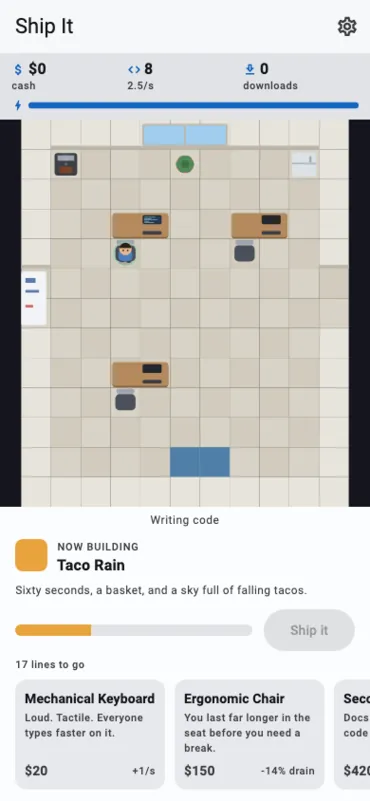
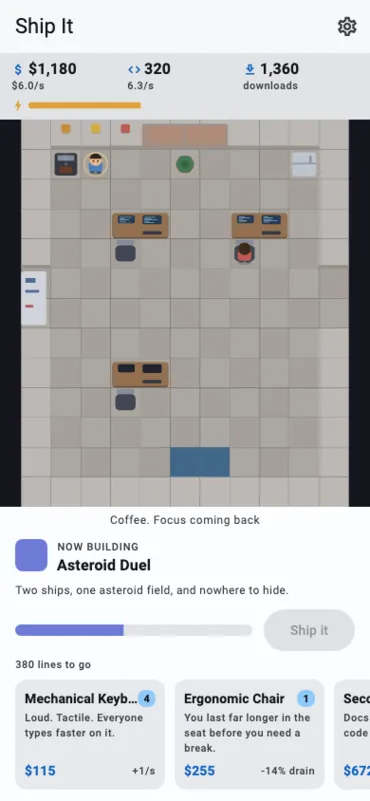
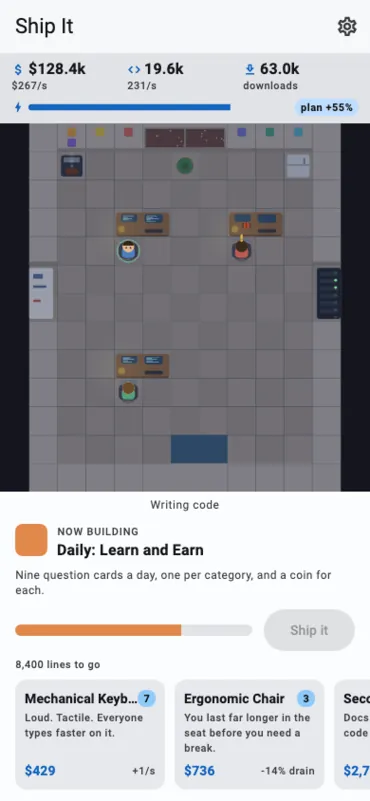
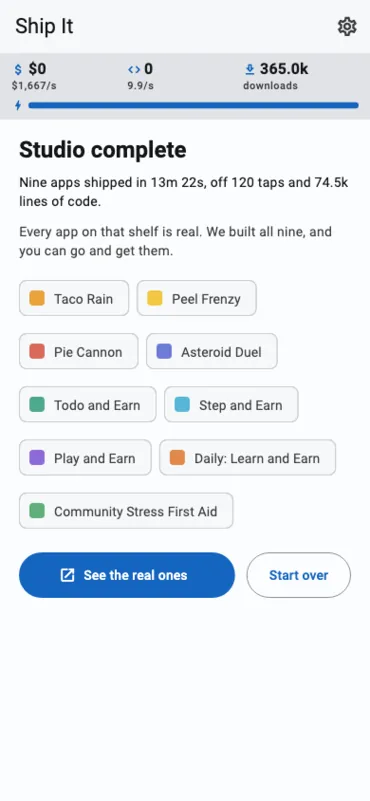
How it plays
- Tap the desk. Every tap writes a line of code, and the number that floats up is what that tap was actually worth.
- Ship when the bar fills. The app on the desk needs a set number of lines. When it has them, the Ship it button wakes up.
- Spend the launch money. Six things to buy, each one visible from the first second, including the ones you cannot afford yet — that is the point of them.
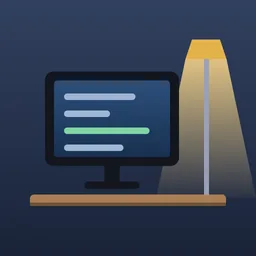
- Watch the office rather than the counter. Every upgrade changes the room: a second monitor, a coffee machine, another desk with somebody at it, a lamp, a rack of servers blinking away in the corner.
- Finish. Nine apps and it is over, with a card telling you how long it took and how many times you tapped.
Features
- Nine apps to build, each costing roughly two and a half times the one before it
- Six upgrades, and every one of them visibly changes the office
- A room that goes from morning to midnight across a run, with the desk lamps taking over as it does
- An ending: seven minutes if you tap flat out, about twelve at a normal pace, and a finish card rather than an endless climb
- No account, no sign-in, no purchases and no ads
- Nothing saved — close the tab and the studio is gone
Frequently asked questions
Is Ship It free?
Yes, and there is nothing in it to buy. No account, no sign-in, no in-app purchases and no advertising. It also has no installable version, so there is nothing to pay for anywhere else either.
How do you play it?
Tap where you want to stand and your character walks there. Sitting at a desk writes code; standing at the coffee machine or the fridge brings your focus back; standing at the whiteboard builds a plan that makes the next stretch of code worth more. A line under the office tells you what the place you are standing in does, which is the whole of the tutorial.
What happens if I just sit at the desk?
It still works, just slowly. Focus drains while you are in the chair and low focus makes every second worth about a third of what it was — it never stops paying entirely, because a game that punishes you for looking away is not one you play with one hand. Measured: using the whole office finishes in about thirteen minutes, living on coffee in about thirty-four, and never getting up at all in about seventy-six.
Can I get it on the App Store or Google Play?
No. Ship It runs in this page and nowhere else. Every other game in this section is a store app with a browser demo beside it; this one was built for the website. Whether it is ever submitted is a decision that has not been made.
Does it save my progress?
No. Progress lasts until you close the tab and then it is gone. Nothing is written to your browser's storage, which is a choice rather than a limitation — a game with an ending does not need a save file.
Are the nine apps real?
Yes. Every app you ship is one of ours, with a real page on this site, and the card at the end links to all nine. The download numbers inside the game are not real: they are a score, and they are not what any of these apps has actually been downloaded.
Is the money in the game worth anything?
No. It buys keyboards and chairs inside the game and stops there. It is not a coin balance, it does not redeem, and it has nothing to do with the four apps of ours that do pay real rewards — those are on our apps page and how they work is on how rewards work.