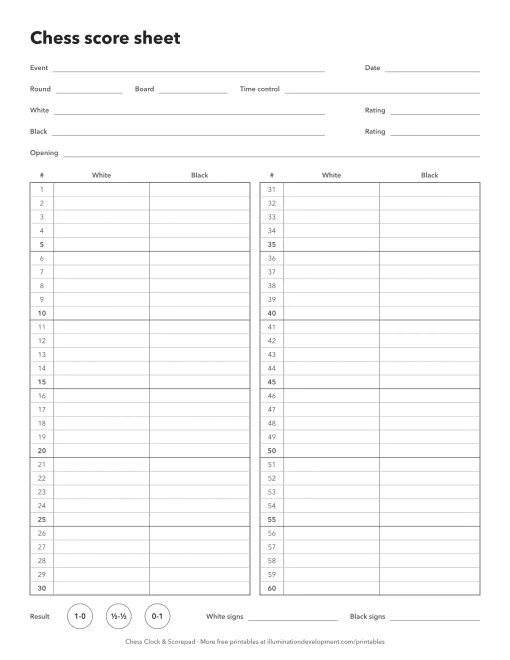
What is on the sheet
The top of the page has lines for the event, the date, the round and board number, the time control, both players with their ratings, and the opening. Below that are sixty numbered moves in two columns, with a white and a black box on each row. Every fifth line is darker, so a move number is quick to find when you look back.
At the foot there are three results to circle, 1-0, ½-½ or 0-1, and a line for each player to sign.
How to fill it in
The time control line takes the clock setting, such as 15+10. What those numbers mean is in how to use a chess clock.
Write each move in algebraic notation: the piece's letter and the square it lands on. K is the king, Q the queen, R a rook, B a bishop and N a knight. A pawn move is just the square, so the first move is often e4.
Add x for a capture (Nxe5), + for check and # for mate. Castling is O-O on the king's side and O-O-O on the queen's side. A pawn that promotes takes the new piece's letter after the square, as in e8=Q.
A game that goes past move 60 carries on onto a second sheet. Number it on from 61.
No chess clock at the board? Use the free online chess clock on a phone or laptop between you.
To play the game back afterwards, type the moves into the PGN viewer. It takes a scoresheet typed by hand and stops at a mistyped move, so a slip in the notation is easy to find.
Chess Clock on your phone
Chess Clock & Scorepad keeps the same record on a phone. You make each move on the board on screen, only legal moves go in, and the move presses the clock. A finished game can be shared as PGN or opened for analysis on lichess. It's free on the App Store and Google Play.
Download on the App Store ▶ Get it on Google Play
Save this sheet to Pinterest · More about Chess Clock

There's a round robin crosstable to go with it. There's more on the printables page.